
Xen Orchestra 6.1
Welcome to our first release of 2026: Pure Storage partnership, new features in XO 6, Kubernetes CCM and much more!


First release of 2026, and also the first update for Xen Orchestra 6! XO 6.1 continues the work we started with the new major version: refining the platform, strengthening its foundations, and steadily improving day-to-day operations. This release focuses on practical improvements driven by real-world usage and community feedback. Oh ! And we also introduced a theme selector!
From architectural changes under the hood to UI refinements, new API capabilities, improved backup visibility, and better tooling around monitoring, licensing, and automation, XO 6.1 is about making the platform clearer, more predictable, and easier to operate at scale.
It also reflects a broader momentum around the project: growing adoption, deeper community involvement, and an ecosystem that continues to expand through partnerships, research initiatives, and events.
👨🚀 Project & Community
A recap and new partners, 2026 will be huge as it starts already well just in January!
2025 in numbers
2025 turned out to be a pretty exciting year for Vates, filled with ongoing growth in both usage and adoption. XCP-ng and Xen Orchestra made impressive progress, with more production deployments and a community that became increasingly involved.
Beyond the numbers, the real highlight was consistency: more users, more infrastructures running Vates VMS every day, and a stronger feedback loop between the community and the engineering team.
 Marc-André Pezin
XCP-ng 8.3 security updates
First round of updates and security fixes for 2026.
 Gaël Duperrey
Pure Storage and Vates partnership
We’re pleased to announce that Vates has officially joined the Pure Storage Technology Alliance Program (TAP).
While we’ve already been working for some time on ensuring compatibility between our solutions, becoming an formal TAP member marks a new step: it formalizes our collaboration and allows us to validate integrations in a structured and official framework.

More details will follow soon, but our objective is clear: bring the performance, intelligence, and advanced capabilities of Pure Storage directly into XCP-ng through a seamless integration.


VEEAM support coming soon
Many of you are waiting for the official release of agentless Veeam support for XCP-ng. Over the past few months, the Veeam teams have been highly responsive and deeply involved in making the integration as smooth as possible. The beta release they published has already received largely positive feedback.
We’re happy to share that we’re now very close to an official release of Veeam support.
In the meantime, Veeam has updated its documentation to explain how to use its backup platform with XCP-ng using the agent-based method:

New industrial research chair
In 2025, the MIAI Cluster approved funding for an industrial research chair named HELIOS. Led by Alain Tchana, this initiative brings together Vates, EasyVirt, and the R&D teams from KrakOS and SANGRIA.
The chair focuses on advancing research into secure, efficient, sustainable, and sovereign cloud and AI technologies, with a strong emphasis on healthcare use cases. Taking part in HELIOS is both a strong signal and a meaningful recognition of the work being done at the intersection of open infrastructure, academic research, and real-world operational constraints.


🎫 Events
2026 is starting strong with both FOSDEM and Tech&Fest. If you are based in Europe, come to say hi!
FOSDEM 2026
FOSDEM 2026 will once again be a key moment for the open source community. For us at Vates, it’s a particularly meaningful edition, as it marks our tenth year of participation in this iconic event for the European, and global, open source ecosystem.
We’ll be present with a booth, where you’ll be able to see live demonstrations of Xen Orchestra, and many members of our team will also take part in technical discussions throughout the event.
 Clément Schilling
Tech & Fest 2026
In February, we’ll be in Grenoble for Tech & Fest 2026. The event brings together players from industry, research, and the public sector to explore concrete, real-world technology use cases, with an emphasis on practical outcomes rather than abstract discussions.
Holding the event in Grenoble has a particular resonance for us, as it’s also where our headquarters are located.
Olivier (Our CEO & co-founder) will be speaking about digital sovereignty from a technical perspective, focusing on what actually works in production environments.
 Clément Schilling
XO 6.1
After last month’s big milestone with XO 6.0, we’re back with a new release: XO 6.1. Let’s take a look at the latest improvements, refinements, and fixes that make the interface and workflows even smoother.
🛡️ Security
At Vates, security is our top priority. We actively monitor for vulnerabilities, fix issues as quickly as possible, and communicate openly so you can take informed action to protect your infrastructure. Here are the latest security notices and important updates for Xen Orchestra and related tools.
VSA-2026-004
We've published a new security notice to the Vates VMS documentation platform: this page includes a detailed breakdown of the vulnerability known as VSA-2026-004, including affected components and potential impact, along with clear, actionable recommendations to secure your environment.
This notice follows our commitment to transparency and proactive security. Admins and operators are encouraged to review it immediately to assess exposure and apply necessary measures.
Click the link below to read the notice:
https://docs.vates.tech/security/advisories/2026/vates-sa-2026-004
💾 Backup
Over the past months, we’ve been steadily improving long-term retention (LTR) management for backups. This month, we continue that work with enhancements that give you even better visibility and control over your backup policies.
LTR tags on backups
Backups now display their Long-Term Retention (LTR) tags in the interface. This makes it clear which backups are governed by long-term retention policies and which follow shorter rules.
With LTR tags front and center, you can quickly confirm that your retention settings are applied correctly, without digging into configuration details or guessing based on dates alone.
Improved Azure and S3 backup support
We’ve fixed an issue affecting full backups of VMs with large disks (over 64 GB) on S3-compatible storage. And since the fix applies to shared code, Azure storage support benefits too. The problem came from underestimating the XVA file size: the backup process wasn’t accounting for the header of each block and the block hash entries.
With this fix, full backups (including encrypted disks) now complete reliably, on both S3 and Azure storage repositories. This ensures consistent and predictable backup behavior across cloud targets.
🥝 Core UI
This month, we’re refining XO 6 and XO Lite to make navigation faster and give you more control over your workflow. UI behavior is getting smarter, visuals are now sharper, and we've also enhanced VM creation.
Auto-scroll to selected stems
When you open a page with an item already selected in the navigation tree, the tree now automatically scrolls to highlight your selection. Your chosen host, pool, or VM is instantly visible. No need to search again!
This is particularly helpful for large infrastructures, where selected items might otherwise be hidden out of view, and force you to scroll manually. The scrolling is smooth and consistent with the existing expand and collapse behavior.
If nothing is selected, the tree behaves as usual. But when an item is selected, it’s now visible immediately, for more efficient navigation.
New and updated icons
Following the new icon system introduced with Xen Orchestra 5.109, we’ve added even more icons from that system. Their design are consistent with our design language and follow a consistent naming pattern.
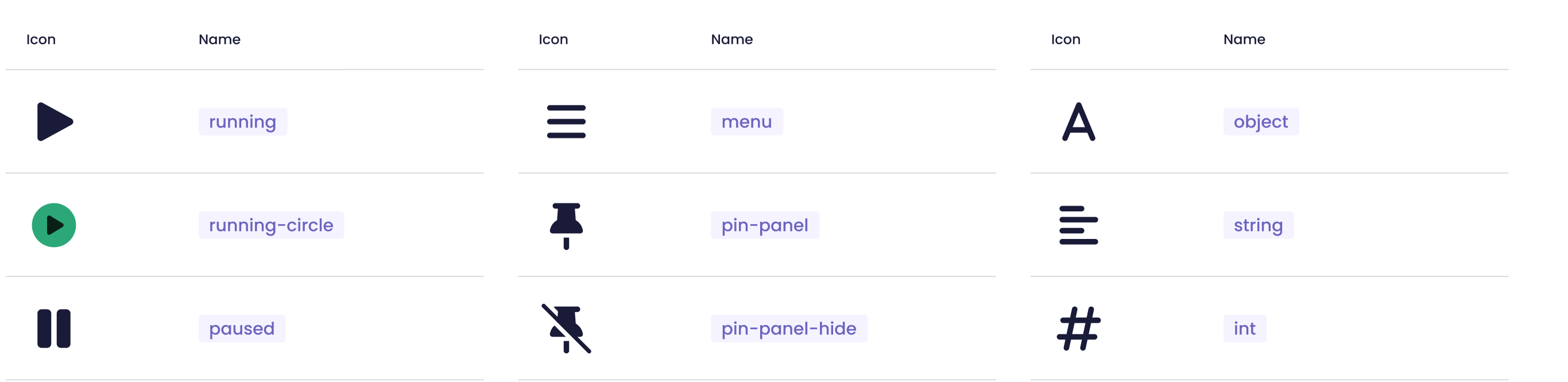
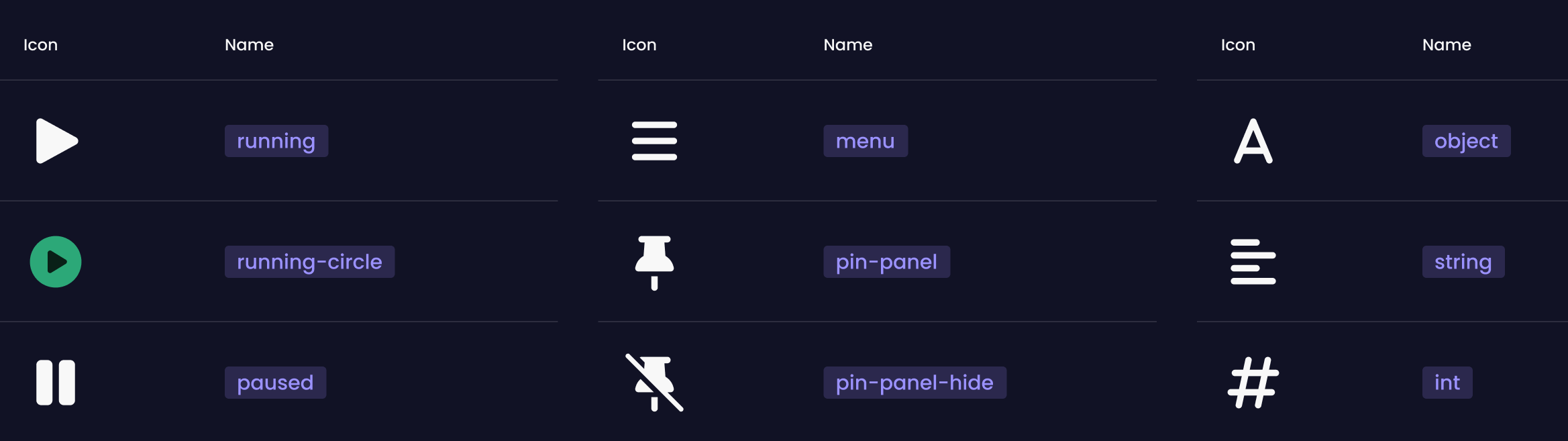
Our new icon system
 Olivier Lambert
vTPM support for new VMs
You can now enable Virtual Trusted Platform Module (VTPM) support when creating a Windows Server VM. Unlocking VTPM enhances security for features like BitLocker encryption.
Simply select VTPM during VM creation. No extra steps are needed after deployment.
🛰️ XO 6
XO 6 became the default Xen Orchestra interface at the end of last year, and it keeps improving. This section highlights the latest improvements and refinements built specifically for XO 6, with a strong focus on usability, consistency, and everyday workflows.
A reminder about feedback and support
Xen Orchestra 6 is continuously evolving, and your feedback plays a crucial role in shaping its future. If you encounter any issues, notice unexpected behavior, or have ideas for improvement, we kindly ask that you avoid opening a support ticket on our portal for XO 6.
Instead, we’ve introduced a dedicated feedback platform designed to gather your insights about how XO 6 is used. There, you can share suggestions, highlight pain points, and upvote existing requests. This ensures the most relevant topics gain visibility. Your input directly influences what we prioritize next.


It's easy to get involved: log in with a third-party account (like Discord or GitHub) or sign up with your email. From there, you can explore existing feedback, upvote the ideas that matter most to you, or add new suggestions if your topic isn’t already covered.
Feel free to also join the dedicated discussion on our forum, right here:
 olivierlambert
Streamlined VM actions
It’s now easier to manage your VMs from the XO 6 interface: the Advanced menu gives you quick access to a full range of actions, covering all common VM states and scenarios.
From here, you can start, pause, unpause, suspend, or resume a VM, as well as perform clean shutdowns and reboots when the guest OS is responsive. If the OS is unresponsive, force actions (like hard reboots or forced shutdowns) are also available. You can even delete a VM directly, all in one place.
This centralized approach makes everyday VM operations faster, clearer, and more efficient, so you can focus on what matters most.
Project architecture refactor
We’ve refactored the XO 6 codebase to improve the overall project architecture.
The goal was to simplify how the different parts of the application are structured and how they interact with each other. This update does not affect the interface or existing features, but makes the project easier to maintain and extend over time.
/src
  /composables
    vm.composable.ts
...
  /components
    /vm
      /dashboard
        DashboardComponent.vue
...
  /utils
    vm.util.ts
Previous project structure
/src
  /modules
    /vm
      /composables
        vm.composable.ts
      /components
        /dashboard
          DashboardComponent.vue
      /utils
        vm.util.ts
New project structure
Theme selector
Xen Orchestra now comes with multiple themes you can choose from. Adapt the interface to your preferences, whether you want better contrast, a different mood, or just something that feels more comfortable for long sessions.
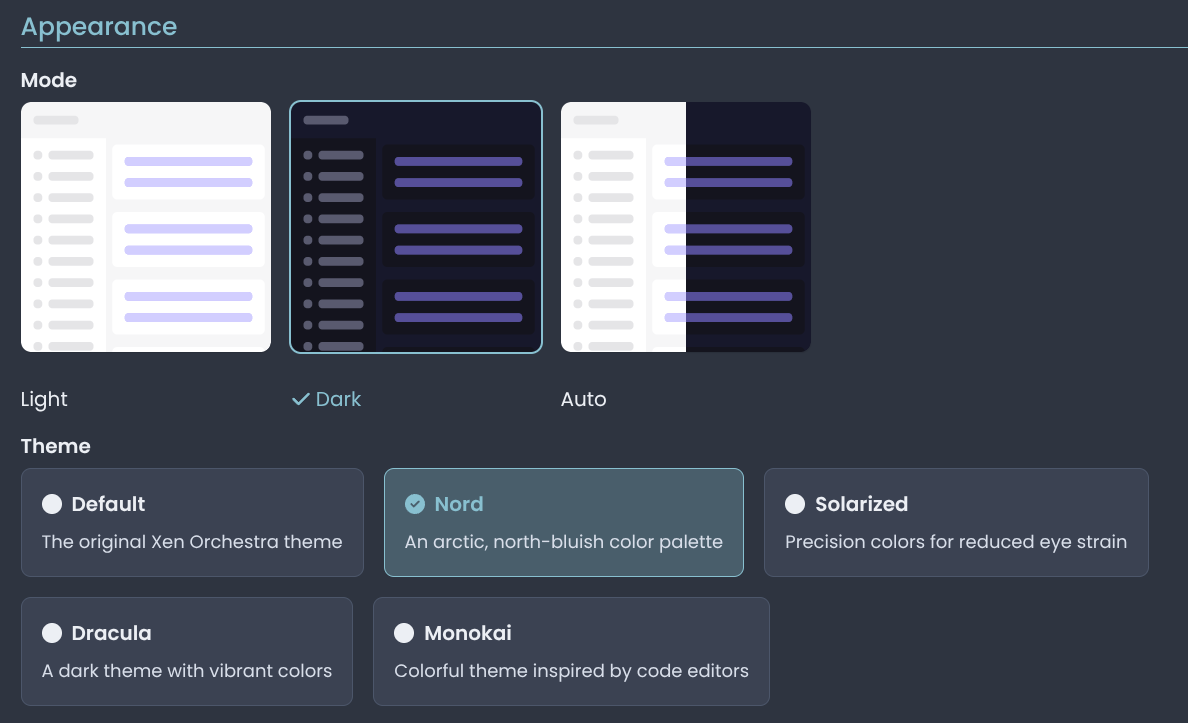
Just select your favorite theme from the interface, and you’re good to go!
Clearer side panels
We’ve removed text ellipsis in side panels, so that labels and values are fully visible. This is especially helpful for longer names, paths, or descriptions: the information is now easier to read at a glance.
On top of that, IDs now appear in monospace font.
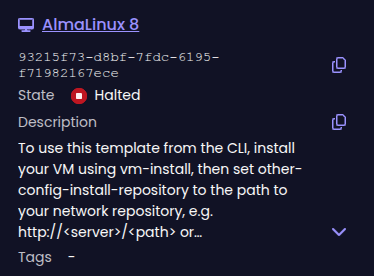
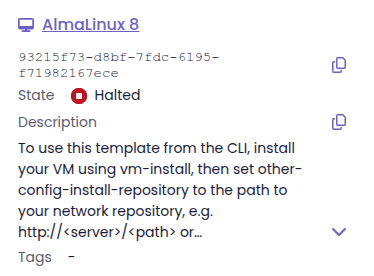
New side panel design, without ellipsis
Consistent disk naming from templates
When creating a VM, its disk name now automatically follows the template’s naming convention at the time of creation. This ensures consistent identification of disks across your VMs, based on the original template name.
If you later rename the template, existing disk names remain unchanged. This will prevent confusion from mismatched or outdated labels, and results in predictable storage naming.
📡 REST API
We’re expanding the API to support more real-world scenarios and bridge the gap between manual and automated workflows. With this month's release, we give you more power over VM storage and networking.
New storage API actions
We’ve extended the REST API with several new endpoints to handle storage attachments and disk operations more directly. You can now create and delete VBDs, connect or disconnect them from VMs, and migrate VDIs through the API, with the following endpoints:
POST /rest/v0/vbdsDELETE /rest/v0/vbds/{id}POST /rest/v0/vdis/{id}/actions/migratePOST /rest/v0/vbds/{id}/actions/connectPOST /rest/v0/vbds/{id}/actions/disconnect
These additions make it easier to automate storage workflows and bring the API closer to what you can already do from the UI, while giving integrators more precise control over VM disks.
New endpoints for VIFs
On top of that, we've added two endpoints to manage virtual network interfaces (VIFs). You can now:
- Create a VIF, with
POST /rest/v0/vifs - Delete a VIF, using
DELETE /rest/v0/vifs/{id}
These improvements give you full control over the VIF lifecycle over the API, so you can automate VM network management easily. No need to go through the XO interface anymore!
☸️ DevOps Tools
We keep investing in the tools around Xen Orchestra to make development, automation, and integration easier and more robust. This section highlights the latest updates to our ecosystem, from infrastructure-as-code and SDKs to Kubernetes and deployment tooling.
Packer plugin update
We released a new version of the Packer plugin for XCP-ng, with multiple improvements. It now supports multiple disks, and the plugin documentation has been updated accordingly. Thanks to AtaxyaNetwork for this contribution!
On top of that, the Packer plugin can now handle IP address changes during builds, thanks to Erik Wahlberger’s input.
Finally, the update comes with a set of bug fixes that improve overall stability. Many thanks to all the community contributors who sent pull requests and helped make this update possible!
 vatesfr



Terraform Provider update
We released a new version of the Terraform Provider from Xen Orchestra. This update enables Secure Boot, which should fix issues related to VM creation or cloning. It also fixed the VDI creation when uploading ISOs and disks to Xen Orchestra.
The update sets
secure_boot to false by default.If you turn it on outside of Terraform, make sure you set it to 'true' in your HCL configuration.
 vatesfr
Official documentation for Talos Linux
Talos (or Talos Linux) is a modern OS for running Kubernetes: secure, immutable, and minimal. Talos is fully open source, production-ready, and supported by the people at Sidero Labs. All system management is done via an API - there is no shell or interactive console.
We’ve added step-by-step documentation to help you deploy and manage Talos Linux with Xen Orchestra.
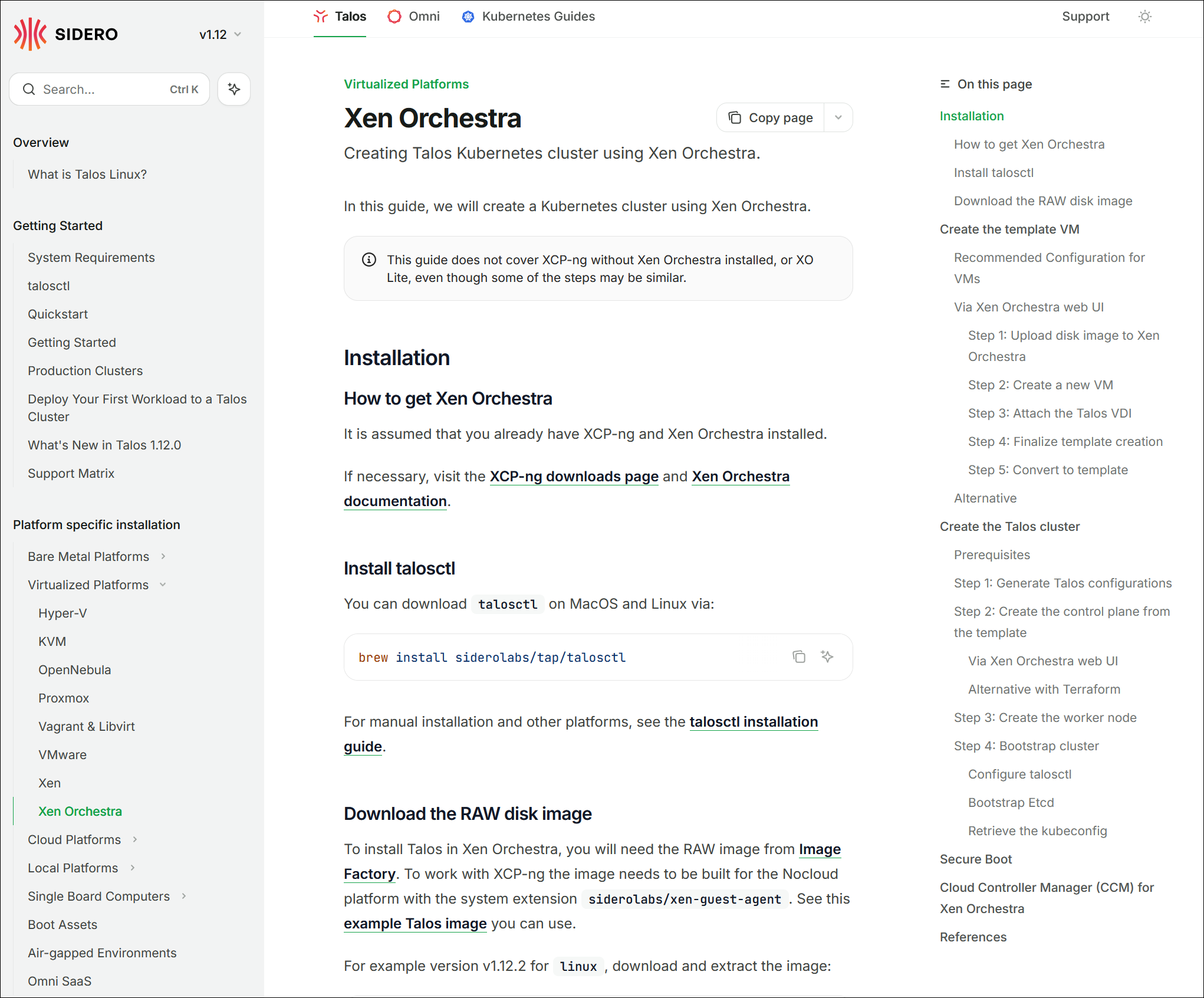
This new guide simplifies onboarding for users running Kubernetes on XCP-ng, and bridges the gap between Talos and XO.


 Echo Nar
Kubernetes Cloud Controller Manager (CCM)
The Xen Orchestra Cloud Controller Manager (CCM) registers new nodes, keeps them labeled with Xen Orchestra metadata, and cleans them up when their backing VM disappears. It supports multiple pools, so a single Kubernetes cluster can span several Xen Orchestra pools.
We’re shipping v1.0.0-rc.1, our first release candidate on the road to a stable 1.0.0! This RC is feature-complete and ready for real-world use.
🚀 Please try it out and share any feedback: bugs, regressions, or usability notes, so we can polish the final release. Thank you for testing and helping us! 🙌
 vatesfr
Golang SDK update
The Go (or Golang) SDK v2 expands on v1’s Secure Boot and VDI import fixes, with significant enhancements. VM and Task services now match the latest REST API, while a new Host service simplifies host data retrieval. Integration tests have also been strengthened to boost reliability.
The v2 SDK is gradually becoming our main library for all the other DevOps tools (Kubernetes drivers, Terraform provider…).
🐦 VMware to Vates (V2V)
We’re always working to make it easier to migrate VMs from VMware to the Vates ecosystem. Below, you’ll find the latest improvements and fixes that help V2V operations run smoothly and predictably.
More reliable Qcow2 imports
We’ve resolved an issue where qcow2 imports could fail at the final stage of a V2V operation. In some situations, the import looked successful until the final step, where it would unexpectedly stop.
Now, V2V imports to qcow2 complete more reliably, including the last stage of the process. Many thanks to our users and the wider community for their vigilance and feedback, which keep helping us improve Xen Orchestra and our tools.
Thanks Andrw0830 for your helping to make this possible!
📖 Documentation & Guides
We keep expanding and refining our documentation to make Xen Orchestra easier to deploy, operate, and monitor. This section highlights the latest guides and updates published over the past month.
RHEL 10 dependency updates
The Xen Orchestra documentation now includes clear, step-by-step instructions for retrieving required software dependencies on RHEL 10–based distributions (such as AlmaLinux, Rocky or CentOS). Since RHEL 10 introduces some differences from earlier versions, the previous documentation left gaps for users deploying on this platform.
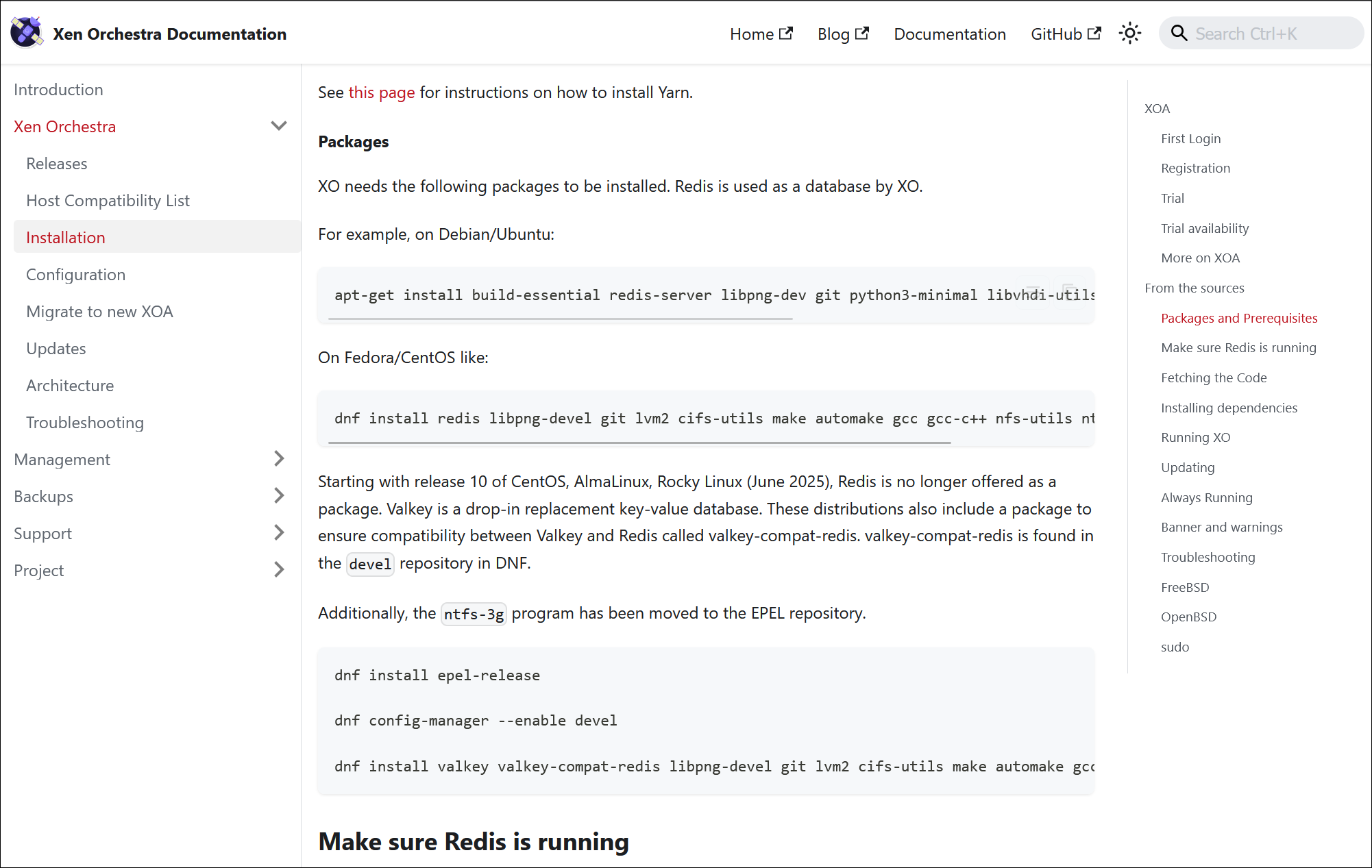
This update simplifies installation and maintenance by detailing the correct repositories and dependency configurations. This reduces guesswork and installation friction.

Prometheus integration
Following last month’s release, we’ve added dedicated documentation for the OpenMetrics and Prometheus integration. The new section explains how to expose metrics from Xen Orchestra and scrape them with Prometheus.
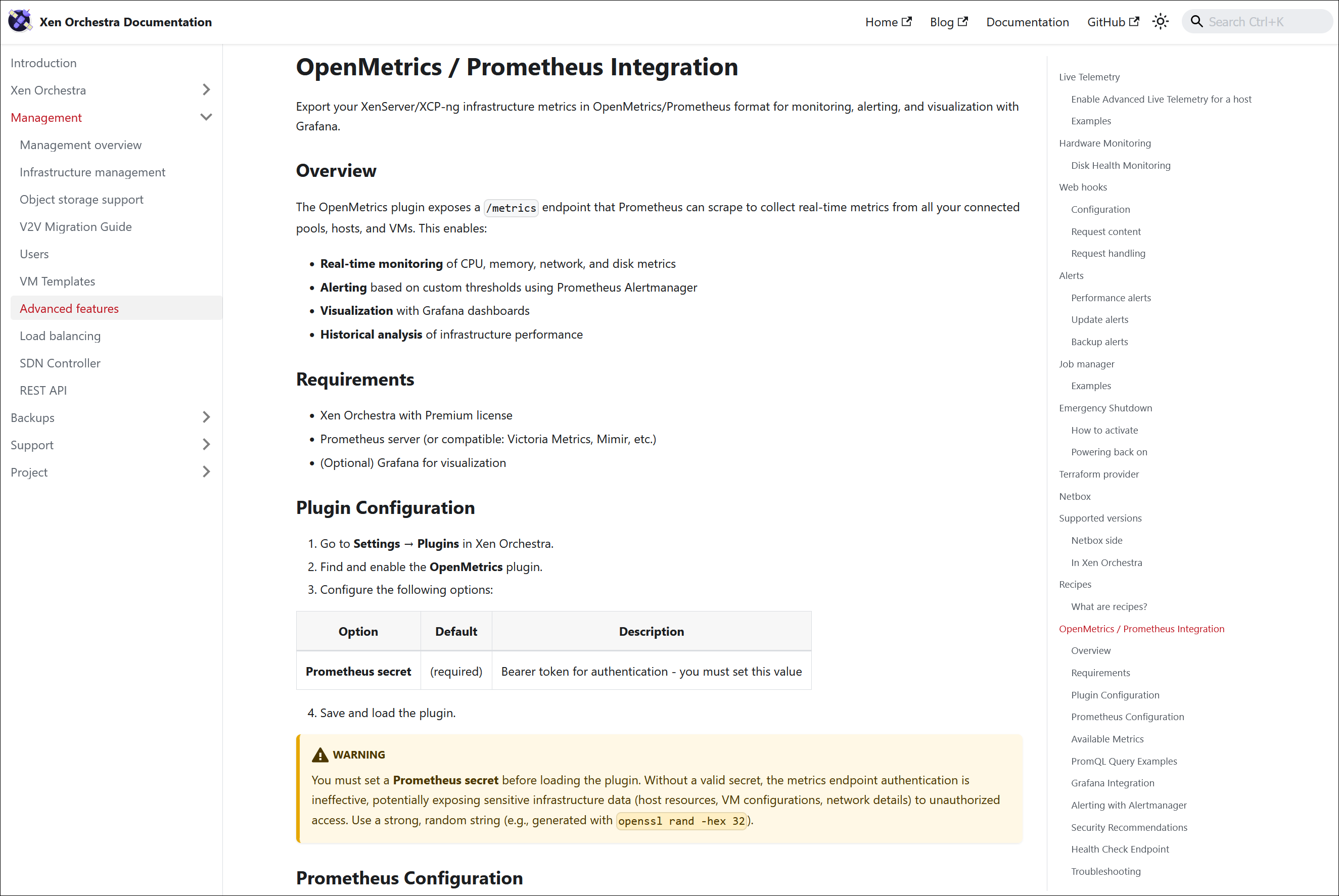
The documentation is available in the Advanced → Recipes section of the XO documentation. It provides clear, practical guidance so you can get start monitoring quickly, without having to piece things together from scattered sources.
 our blog post series about it
🔦 Community spotlight
The Xen Orchestra community continues to create valuable tools, resources, and projects that expand what the platform can do. Here, we showcase some of the most notable contributions and updates from users and collaborators, each one adding to the strength and diversity of the XO ecosystem. Your ideas and work make this community thrive!
XenAdminQt v.0.0.3-alpha
This month sees the new release of XenAdminQt: a lightweight Qt-based client for managing Xen environments.
A special thanks to Petr Bena for his dedication and contributions to the Xen community!
 benapetr
To know more on XenAdminQt, check out the dedicated thread on our forum:


🌐 Translations
Xen Orchestra is used globally, and accurate translations are essential to ensure everyone can use it effectively. Here, we share the latest language updates and recognize the community contributors who help maintain these translations. Your work makes the platform more inclusive for all users.
16 languages updated
A big thank you to our community for their ongoing efforts in translating Xen Orchestra!
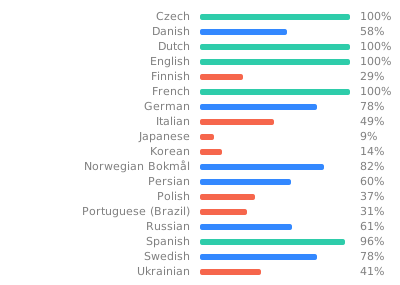
This month, lots of languages were updated: 16! Namely: Czech, Danish, German, Spanish, Farsi, Finnish, Italian, Japanese, Korean, Norwegian (Bokmål), Dutch, Polish, Brazilian Portuguese, Russian, Swedish, and Ukrainian.
Want to help translate Xen Orchestra or improve existing translations? You’re more than welcome to join in here.
🆕 Misc
Not every enhancement fits into a single category, but each one contributes to a better experience in your daily operations. This month, we gave particular care to how you can monitor storage and energy consumption, with access to even more metrics.
SR capacity metrics
The OpenMetrics plugin now exposes capacity information for Storage Repositories, not just performance data. Until now, SR metrics were limited to I/O statistics like IOPS, throughput, and latency, which meant storage usage itself was not visible in Prometheus.
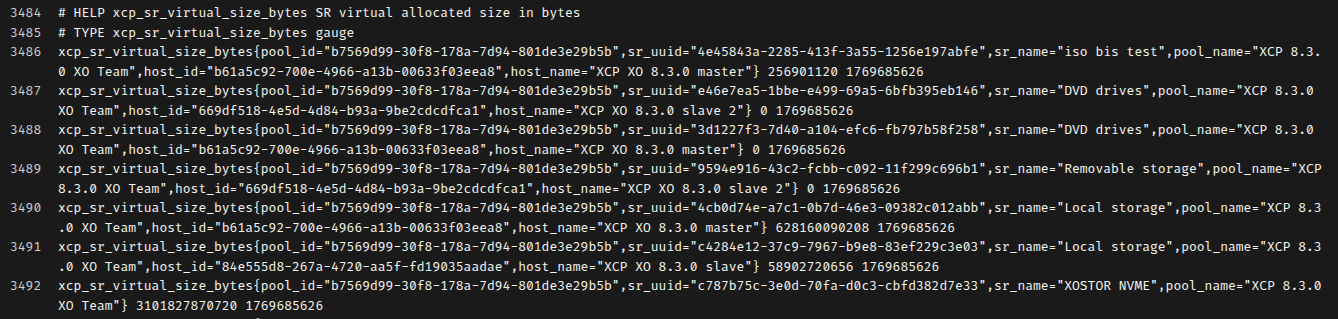
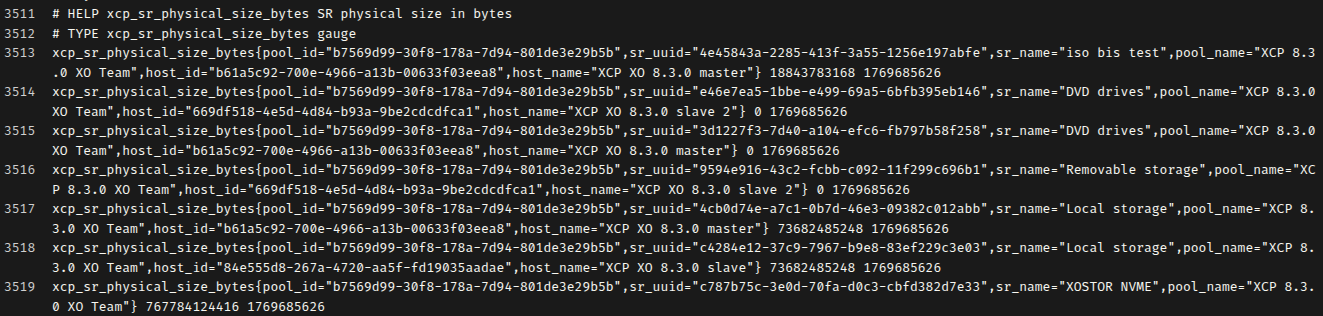
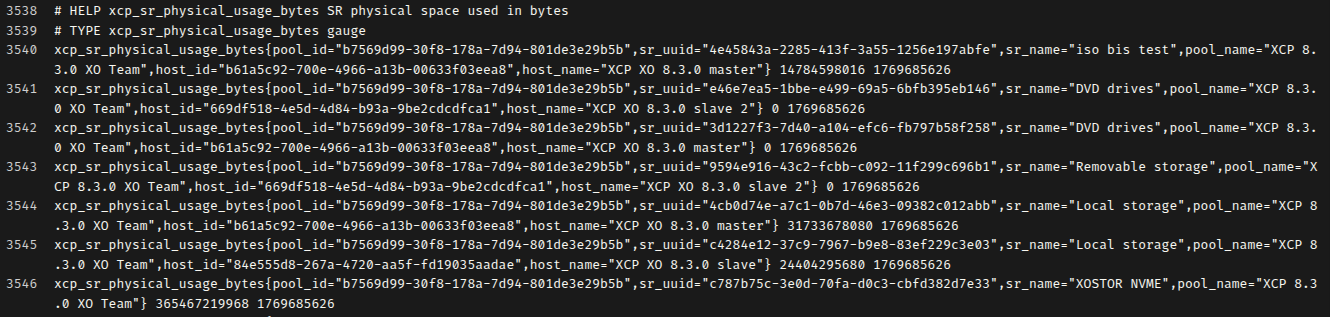
SR capacity metrics exposed by the OpenMetrics plugin
Three new metrics are now available: the virtual allocated size, the physical size of the SR, and the actual physical space used. Together, they make it easier to track capacity and anticipate saturation. This closes an important visibility gap and brings storage monitoring closer to what operators expect from a production-ready observability setup.
Energy insights in DC Scope
DC Scope in Xen Orchestra now provides energy consumption estimates, using minimum and maximum power values. This gives you an instant view of potential energy use, without manual calculations or using external tools.
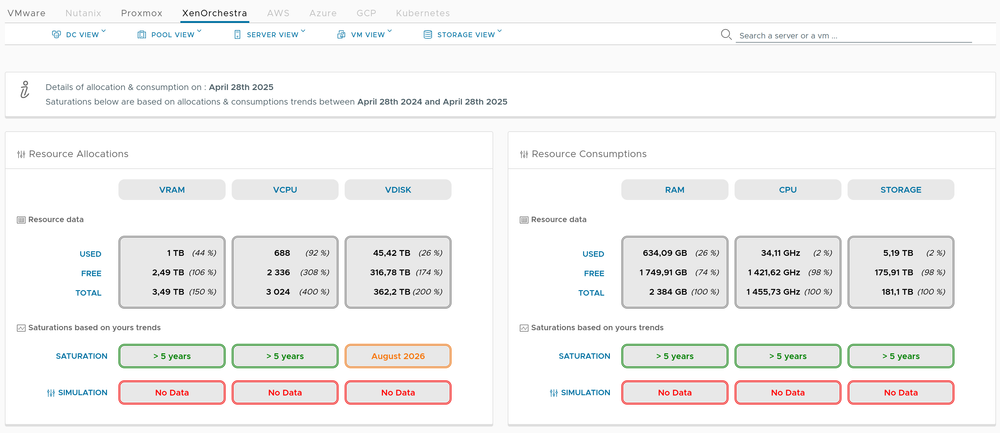
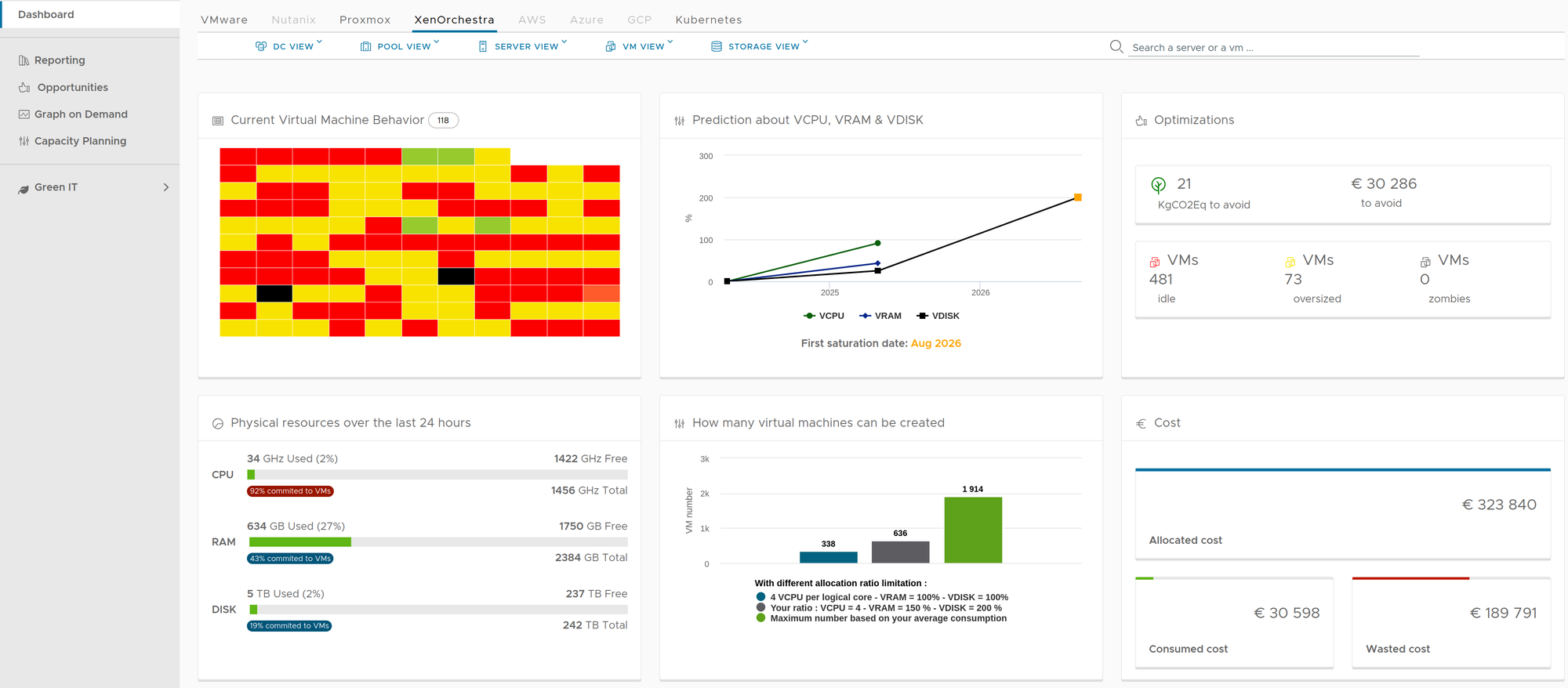
Preview of DC Scope in Xen Orchestra
With this feature, you can plan more efficiently and monitor infrastructure sustainability. Plus, you can optimize both costs and environmental impact.
Move management IP to another PIF
You can now move a host’s management IP from one PIF to another directly, without having to remove and recreate it.
For now, you can only move a management IP to another PIF by using the API. We’re planning a future update so you can do it from the Xen Orchestra interface as well.
This feature was developed in response to a user request submitted to our support team. Community feedback is a primary driver behind our roadmap. We’re constantly refining Xen Orchestra and the API, based on how you use it in the real world, from small workflow tweaks to major new capabilities.